Scholarships

Excellence and opportunity

From its earliest days, St Paul’s College has awarded scholarships to both acknowledge excellence and open doors of opportunity. They recognise students who have achieved outstanding results, while also ensuring that financial background is never a barrier to joining Australia’s first university college.

For generations, these scholarships have transformed lives—enabling students pursue their studies at the University of Sydney while experiencing the unique traditions, friendships, and opportunities of college life.

Each year, a wide range of scholarships are offered. Some reward academic achievement, others provide vital support for those with promise and ambition. All of them reflect the values of St Paul’s: excellence, opportunity, and community.
Scholarships and selection criteria

We have a range of scholarships available for students who have a financial need and/or outstanding academic achievement.

This includes students who:

  • Demonstrate academic excellence and/or outstanding ability,
  • Choose particular fields of study i.e medicine, law, maths, or engineering,
  • Are all-round achievers and/or make positive contributions to the community,
  • Have family incomes that may present barriers for them,
  • Attended a government secondary school,
  • Grew up in rural or regional Australia,
  • Identify as Aboriginal or Torres Strait Islander.

Scholarship applications will only be considered once a separate College Application has been submitted. Applications close 04 September 2026.

All-round excellence

Since 1926, multiple generations of the Albert family has given St Paul’s their time, support, guidance, counsel, vision, and loyalty, creating an impact impossible to fully measure.
 
The Albert Scholarship honours the generosity and legacy of Robert Albert AO RFD RD (1934–2024), a lifelong friend and benefactor of St Paul’s College. A distinguished businessman, community leader, and Old Pauline (1953 – 1956), Robert believed deeply in the value of education and the transformative experience of College life. His philanthropy has supported generations of students at St Paul’s, ensuring that excellence and opportunity continue to flourish within the Pauline community.
 
Criteria
The scholarship is awarded to students who demonstrate all-round achievement. Candidates for these scholarships will have high level sporting, musical, or other abilities, in addition to high academic merit, and financial need will be taken into consideration.
 
Value
25% – 75% of College fees.
The Grainger Scholarship was established through the generous bequest of Edwin Grainger and his wife, May Grainger. Born in England, Edwin came to Australia as a young man and began his career with the Bank of New South Wales. He married May Greville in 1905 and served at several country branches before spending twenty-five years as branch manager at Inverell.
 
After retiring from the bank, Grainger pursued pastoral interests in north-western New South Wales. A keen singer and organiser of musical occasions, he was also a supporter of local rural schools and community life. Later, Edwin and May settled in Sydney, where they became known for their generous philanthropy. Edwin died in 1930, aged 80, and May in 1937.
 
In 1939, the first sixteen Grainger Scholarships were awarded at St Paul’s College. Since then, more than 150 Paulines have been Grainger Scholars, continuing a tradition of opportunity, scholarship, and service to the community.
 
Criteria
The Scholarship is awarded to rural students who demonstrate all round achievement. Candidates for these scholarships would have high level sporting, musical or other abilities, in addition to academic merit.
 
Value
Up to 50% of College fees.
The Glendonbrook Scholarship is supported by the Glendonbrook Foundation, established by Michael Bishop, Lord Glendonbrook. A pioneer in the aviation industry and long-time philanthropist, Lord Glendonbrook has dedicated his Foundation to advancing education and community life in both the United Kingdom and Australia. Since its establishment in 1987, the Foundation has donated more than £35 million to over 100 charities, and St Paul’s College is very proud to be among its beneficiaries.
 
Lord Glendonbrook and his husband Martin have taken a keen personal interest in the life of the College, regularly visiting and meeting with scholars whose education they have helped to support. In 2026 they have generously funded 16 scholarships.
 
Criteria
These scholarships are awarded to talented students who would not otherwise be able to afford to reside at College.
 
Value
Up to 50% of College fees.

Anglican heritage

This scholarship is funded through the generosity of the St Paul’s College Foundation.
 
The Augusta Priddle Memorial Scholarship was founded in July 1885 by the Reverend Charles Frederick Durham Priddle, in memory of his wife, Jane Augusta Priddle (née Norton) (1828-1883).
 
Charles Priddle (1814–1897), a Fellow of the College from 1875 to 1897, had contributed ₤25 to the founding of the College. The Priddles were married on 25 February 1851, and, at the time of the scholarship’s establishment, he was Rector of St Luke’s, Liverpool.
 
Augusta’s father, James Norton, also subscribed ₤50 towards the founding of St Paul’s College, and her brother, James Norton, was a Fellow of the College (1869–1906).
 
Their two sons, Robert (1866–1950) and Alfred (1869–1940), both attended St Paul’s, and Robert later supplemented the scholarship through a bequest.
 
Criteria
The Priddle Scholarship is awarded to children of clergy studying at St Paul’s College.
 
Value
Up to 50% of College fees.
The Bishop Arnott and Bishop Maxwell Fellowship honours two distinguished Anglican leaders and former Wardens of St Paul’s College.
 
The Rt Rev’d Felix Arnott CMG served as Warden of St Paul’s College from 1946 to 1963, a period of significant growth following the Second World War marked by strong academic achievement and a flourishing of cultural life. A scholar of Keble College, Oxford, Arnott later served as Coadjutor Bishop of Melbourne and Archbishop of Brisbane, and played a leading role in theological education in Australia.
 
One of Arnott’s most gifted students at St Paul’s was Maxwell Thomas, who arrived at the College at just sixteen as a Bundock Scholar. After completing degrees in Arts and Divinity and undertaking doctoral studies in New York, Thomas served the Anglican Church as Bishop of Wangaratta before returning to St Paul’s as Warden from 1985 to 1994.
 
Established through a generous bequest from Dr K.D.G. Edwards, a Pauline and distinguished medical researcher, the Fellowship recognises the commitment of Arnott and Thomas to scholarship and theological education.
 
Criteria
This scholarship provides support for a student or past Pauline undertaking further study in theology.
 
Value
$10,000.

Degree specific

This scholarship is funded through the generosity of the St Paul’s College Foundation.
 
The Henry Abbott Scholarship was founded in October 1885 by Thomas Kingsmill Abbott in memory of his son, Henry William Abbott, a solicitor who died unmarried at Milson’s Point on 8 October 1878, aged 26.
 
T.K. Abbott, who had served as Secretary of the General Post Office, Sydney, died in London on 6 May 1885, leaving a bequest of ₤1000 to establish a scholarship for a resident of St Paul’s College.
 
He was also the uncle of Sir Joseph Abbott (College Fellow 1891–1900) and The Rev’d Thomas Kingsmill Abbott (Undergraduate 1885–1887, Scholarship Recipient 1885–1887, College Fellow 1896–1902, Vice-Warden 1900–01).
 
The Abbott Scholarship was first awarded in 1889 to Cuthbert Blacket.
 
Criteria
The scholarship is awarded on academic merit to a student undertaking an Education degree.
 
Value
Up to 25% of College fees.
 
This scholarship is funded through the generosity of the St Paul’s College Foundation.
 
The Aspinall Scholarship was founded in 1864 by Mrs Sophia Ann Hall Aspinall (1810–1874) in memory of her husband, Edward Aspinall. She and her brother, William Hall Palmer, were among the original subscribers to St Paul’s College in the 1850s, and Mrs Aspinall was one of the College’s most generous benefactor in its early years.
 
Alongside her enduring support for the College, she was devoted to children’s and women’s charities in Sydney, including the Destitute Children’s Asylum and the Female School of Industry, and contributed to the building of St Andrew’s Cathedral. Her annual gifts from 1865, and a fund established in 1872, created one of the College’s first enduring scholarships—a lasting legacy of her generosity and vision for education.
 
Criteria
The scholarship is awarded on academic merit to a student undertaking either an Economics or Commerce degree.

Value
Up to 25% of College fees.
This scholarship is funded through the generosity of the St Paul’s College Foundation.
 
The Kemp Scholarship was founded in 1880 through the bequest of Mrs Stella Kemp, in memory of her husband Charles Kemp (1813–1864), former joint-proprietor of the Sydney Morning Herald and an original Fellow of St Paul’s College (1855–64). Charles Kemp was an early benefactor of the College, contributing £300 to its foundation and taking a close interest in its success. He also supported Moore College and fundraising for St Andrew’s Cathedral.
 
The first Kemp Scholarship was awarded in 1880 to Albert Piddington (1880-83), who went on to a distinguished career as a barrister, politician, and a long-serving member of the University of Sydney Senate. His achievements reflected the scholarship’s early purpose: to encourage excellence and service in both professional and public life.
 
Criteria
The scholarship is awarded to a student studying Arts or Law.
 
Value
Up to 25% of College fees.
This scholarship was created in 2007 by Gary McConnell (1984 – 1986). Gary was an early Foundation Scholar and Senior Student in 1986. After graduating from the University of Sydney, Gary went on to Cambridge to a PhD in pure mathematics. He was inspired to create a scholarship for students for whom attendance at College would not normally be within their financial capability.
 
Criteria
The scholarship is awarded on academic merit to students undertaking degrees in traditional academic disciplines (e.g. arts, science) who would not otherwise be able to afford to reside at College.
 
Value
Up to 75% of College fees.
 
Sir Ian McFarlane (1923–2008), in College from 1941 to 1946, was a pioneering Australian businessman, engineer, and philanthropist. Well known for his leadership in the resources sector, he was equally committed to supporting education, medical research, and community causes.
 
Sir Ian was knighted in 1984 for services to business and community. His bequest provided for scholarships at St Paul’s, opening doors for future generations and reflecting his lifelong belief in education, opportunity, and service.
 
Criteria
The scholarship is awarded on academic merit to a student undertaking Bachelor of Medical Science or Bachelor of Science (Medicine)
 
Value
$5,000
This scholarship is funded through the generosity of the St Paul’s College Foundation.
 
This scholarship honours Patrick Cecil Greenland MBE, who served as Tutor and Sub-Warden of St Paul’s College from 1935 to 1938. Remembered as a distinguished scholar, gentleman, and much-loved figure in College life, it was said to be “difficult to imagine the life of the College apart from him.” He brought to Paul’s an inspirational blend of intellectual depth, cultural breadth, service and pastoral care.
 
Greenland went on to serve as Secretary of the Australian Atomic Energy Commission, for which he was awarded an MBE. Through bequests, he initiated a music scholarship at the University of Adelaide, and this scholarship at St Paul’s College, which continues his legacy of intellectual curiosity, leadership, and the affection he inspired in Paulines during his tenure since.
 
Criteria
The scholarship is awarded on academic merit to a student undertaking a Bachelor of Arts.
 
Value
25% of College fees.
This scholarship is funded through the generosity of the St Paul’s College Foundation.
 
The W.C. Bundock Scholarship was established through the bequest of Mary Ellen Murray-Prior (1845–1923), née Bundock, in memory of her parents. Her brother, Charles ,was in College 1875-76. A fearless horsewoman, skilled anthropologist, and early benefactor of higher education, she married Queensland pastoralist and MP Thomas de Montmorency Murray-Prior in 1902, but was widowed soon after. She went on to manage the Maroon station in south-east Queensland and built a meticulous collection of Aboriginal cultural artifacts, now held at the Australian Museum, Sydney, and the Rijkmuseurn voor Volkenkunde, Leiden.
 
In her will, she left £2,000 to St Paul’s College to found the W.C. Bundock Scholarship, alongside a matching gift to the Women’s College. Among its early recipients was Max Thomas, later Warden of St Paul’s College, demonstrating that her gift shaped both students and leaders within the Pauline community for generations.
 
Criteria
The scholarship is awarded on academic merit to a student undertaking a Science degree.
 
Value
Up to 50% of College fees.
The Webster family has a long and distinguished association with Veterinary Science at the University of Sydney, spanning three generations of veterinarians.
 
In 1923, Dr Arthur F. Webster graduated from the Faculty of Veterinary Science. His son, Dr Arthur C. Webster, served on the Council of the Post Graduate Foundation, including a term as President, and the Executive Committee of the Veterinary Science Foundation. In 2002, he was appointed an Honorary Fellow of the University of Sydney. Continuing this tradition is, Dr Alister Webster, a Pauline (1996-98) and a USYD veterinary graduate.
 
The Webster family’s enduring commitment to the advancement of veterinary medicine and access to education is reflected in their passion for creating opportunities for rural students who may not otherwise be able to pursue studies in Veterinary Science at the University of Sydney.
 
St Paul’s College is proud to partner with the Webster family in supporting this important initiative through the Webster Scholarship.
 
Criteria
The scholarship is awarded to rural students, with a low SES status (as assessed in the UAC form) and have been accepted into the BVS/DVM program.
 
Value
75% of College fees.

Existing students

These scholarships are funded through the generosity of the St Paul’s College Foundation.
 
Developing leadership skills is central to the Pauline experience, and a number of scholarships are awarded each year to recognise and support students who take on key roles within the College community.
 
These include Junior Deans, fourth-year students who take on significant leadership responsibilities within College life; Peer Support Leaders, who mentor and guide new students as they transition to College; and Academic Leaders, who work closely with the Senior Tutor to support the tutorial program at St Paul’s College.
 
Criteria
These leaderships are applied for and awarded to current students at St Paul’s College who have demonstrated leadership qualities and a strong sense of the College values.

Value
10% – 50% depending on position.
This scholarship is funded through the generosity of the St Paul’s College Foundation.
 
The Stapley Edwards Scholarship was the first scholarship to be established by a former student of St Paul’s. Alfred Stapley Edwards (1904–1945), who entered College in 1924, graduated BSc before a career with Johnson & Johnson, where he led the company’s establishment in Sydney as managing director.
 
The son of Clarence Edwards, managing director of David Jones, Stapley died at just 41 while returning from overseas business travel. In his will, he left £1,000 to St Paul’s, a gift later supplemented by his father and widow, creating a lasting scholarship in his memory.
 
Criteria
The scholarship is awarded to the continuing undergraduate resident who attained the highest WAM at university in the preceding year.
 
Value
25% of College fees.

Externally awarded

The Asha program has been transforming lives in Delhi’s slum communities since 2008. Building on its primary and secondary education initiatives, the Asha team identifies and supports students who demonstrate strong academic performance, aptitude, and motivation, but lack the financial means to pursue tertiary study. Outstanding Asha students have the opportunity to gain admission to universities in India and abroad, including the University of Sydney.
 
The St Paul’s College Foundation supports the partnership between Asha and the University of Sydney by offering full residential scholarships covering 100% of College fees. These scholarships enable exceptional Asha students to live and study within a supportive academic community while completing their degrees at the University of Sydney.
 
Criteria
No application required. Nominations will be made by the Asha Community Health and Development Society.
 
Value
100% of College fees.
This scholarship is funded through the generosity of the St Paul’s College Foundation in partnership with the University of Sydney.
 
The Gadigal Scholarship at St Paul’s College is offered through a partnership between the St Paul’s College Foundation and the University of Sydney’s Gadigal Program, which supports Aboriginal and Torres Strait Islander students to access and succeed in higher education.
 
Named in honour of the Gadigal people, on whose land the University and College stand, these scholarships provide financial assistance and accommodation at St Paul’s. They reflect the College’s commitment to providing opportunities for Aboriginal and Torres Strait Islander students to flourish both academically and socially while pursuing their studies in a welcoming college community.
 
Criteria
The scholarship is awarded to Aboriginal and Torres Strait Islander students. Application is via the University of Sydney website.
 
Value
100% of College fees.
The mission of the Governor Phillip Scholarship is to invest in outstanding young Australian and British students, from all fields of endeavour, to create an inspirational generation of leaders, academics and global citizens. The scholarship offers a fully funded postgraduate degree and an opportunity to be educated at some of the world’s leading universities.
 
Benefits include:
– a multicultural, international experience
– lifetime access to alumni communities worldwide
– bespoke forums and leadership events

Criteria
A range of academic courses may be considered (typically one or two-year Master’ degrees), but in general scholarships are awarded to the following programmes:
 
– at the University of Sydney, MPhil programmes in the School of Social and Political Sciences
– at the University of Oxford, MPhil programmes in the Department of Politics and International Relations
 
Value
 
The Osborne Scholarship was founded in 1918 through the bequest of Kate Cunningham Moffatt (1849–1918), in memory of her grandfather Dr John Osborne RN, a naval surgeon and early Wollongong settler. Mrs Moffatt’s family had close ties to St Paul’s, with her Osborne cousins — Hamilton, John, Oliver, and Duncan — in residence during the 1880s and 1890s. She directed that the scholarship support students in Medicine who were or had been resident at the College.
 
First awarded in 1920, the Osborne Scholarship today offers up to $10,000 for second-, third-, or fourth-year Doctor of Medicine students at St Paul’s, and is applied for through the University of Sydney.
 
Criteria
The Burton Scholarship was founded in 1839 by Sir William Westbrooke Burton (1794–1888), a judge of the Supreme Court of New South Wales, for students at The King’s School, Parramatta. The scholarship was endowed with a sum of ₤1000, raised by Burton’s admirers as a gift upon his departure from the colony.
 
Born in England, Burton was appointed to the Supreme Court of the Cape of Good Hope in 1827 and transferred to the Supreme Court at Sydney in 1832. After a distinguished judicial career that also included service in Madras, he returned to Sydney in 1857, later serving as President of the Legislative Council (1858–1861). Though married twice, he had no children.
 
Today, the Burton Scholarship continues to support students from The King’s School who enter St Paul’s College, maintaining a connection that reflects Sir William Burton’s enduring legacy of education and public service.
 
Criteria
The scholarship is for students proceeding from The King’s School to St Paul’s College, and is wholly administered by the school.
 
Value
Contact The King’s School Parramatta for further information.

Government school

This scholarship is funded through the generosity of the St Paul’s College Foundation.
 
The Reverend Canon Alfred Hamilton Hewlett Stephen was the eldest son of Sir Alfred Stephen, born in Hobart on 24 April 1826 and educated at Cambridge. A devoted clergyman and one of the College’s earliest and most influential founders, Canon Stephen served as a Fellow of St Paul’s College from 1855 until his death at Hunter’s Hill on 20 July 1884.
 
His entire ministry was devoted to St Paul’s Church, Redfern, the parish from which the College takes its name. Deeply committed to social welfare, he also served as founding secretary and later president of the Society for the Relief of Destitute Children, a cause to which he gave tireless support.
 
Following his death, a public subscription was raised in his honour, and in 1902, the Canon Stephen Memorial Scholarship was established with a capital of £761.
 
Today, the scholarship commemorates Canon Stephen’s vision, service, and dedication to faith and learning at St Paul’s College.
 
Criteria
The scholarship is awarded to an undergraduate student coming from a government school in recognition of both academic potential and personal character.
 
Value
Up to 50% of College fees.

Hardship

Dr Edward Waddy Pockley was a member of a remarkable family whose contributions span medicine, law, education, and the Church. He was educated at Barker College, The Armidale School, and the University of Sydney, where he studied Medicine. After specialist training in ophthalmology at Oxford and in London, he returned to Sydney and was appointed Honorary Ophthalmic Surgeon at Royal Prince Alfred Hospital. There he made major contributions to his field, pioneering intra-capsular cataract surgery in the early 1950s and training generations of medical students and registrars.
 
Dr Waddy Pockley was a generous benefactor to education throughout his life. The Pockley Scholarship honours his lifelong commitment to learning, service, and the advancement of medicine—values that continue to inspire future generations of Paulines.
 
Criteria
The scholarship is awarded to a student who is suffering financial distress, misfortune and unexpected hardship would not otherwise be able to afford to reside at College.
 
Value
Up to 50% of College fees.

Merit

This scholarship is funded through the generosity of the St Paul’s College Foundation.
 
The Caird Scholarship was founded in 1923 through the bequest of Elizabeth Richardson Caird (1873–1922), in memory of her father, George Sutherland Caird, a Sydney businessman with ties to Glasgow and Oxford. Known for her quiet generosity, Elizabeth Caird supported many charitable institutions in Sydney and Melbourne, particularly those connected with children.
 
Her will provided for scholarships at the University of Sydney, St Andrew’s College, and St Paul’s College, each to bear her father’s name. At St Paul’s, the scholarship was first awarded in 1932 to Frank Rush, later a canon of St Andrew’s Cathedral and a Fellow of the College—beginning a tradition of support that continues to this day.
 
The scholarship is awarded to the first year student who attained the highest ATAR.
 
Criteria 
The scholarship is awarded to the first year student who attained the highest ATAR. 
 
Value
Up to 25% of College fees.
The Wallace Anderson Scholarship was established in 1984 by Jocelyn Anderson (née Josephson) in memory of her husband, William Wallace Anderson. Jocelyn was the granddaughter of Joshua Frey Josephson, one of the College’s original and most prominent subscribers.
 
At the outbreak of WWII, William Anderson joined the RAAF as one of the first Australian pilots trained under the Empire Air Scheme. He was deployed to England and rose to the rank of Flying Officer. Tragically, he was reported missing and presumed killed in action on 18 June 1941, following a crash near Boulogne. He was 27 years old. His body was never recovered.
 
The Scholarship was established by his widow, Jocelyn, and his two sisters, Jean Healey and Irene Ashton, to honour his service and sacrifice.
 
Criteria
The scholarship is awarded to student entering from the King’s School with the highest ATAR.

Candidate is not the recipient of another scholarship awarded by the Council or Foundation.
 
Value
Up to 10% of College fees.

Music

This scholarship is funded through the generosity of the St Paul’s College Foundation.
 
John Booth was a resident of St Paul’s College from 1969 to 1974, where he was enthusiastically involved in many aspects of College life, particularly music, debating, theatre, and writing. He returned to serve as Assistant Sub-Warden from 1977 to 1983, and as a Fellow of the College from 1984 until his untimely death in 2011.
 
John’s deep devotion to St Paul’s extended well beyond his student years. Having been a scholarship recipient himself, he understood the profound impact of financial support on a student’s educational journey. Through his generous bequest, he has ensured that future generations of Paulines will benefit from the same opportunities that shaped his own life and love of College.
 
Criteria
The scholarship is awarded to a student involved with the College Choir who is undertaking studies at the Sydney Conservatorium of Music, in recognition of musical excellence and contribution to the cultural life of St Paul’s College.
 
Value
Up to 50% of College fees.
This scholarship is funded through the generosity of the St Paul’s College Foundation.
 
In December 1885, the College Council received notice of a gift of ₤1000 from an anonymous donor. The donation was later referred to as the Starling Foundation, and the benefactor was acknowledged as Mrs Elizabeth Jane Starling (nee Dudley), widow of Mr John Penny Starling of Norwood Hall, Marrickville.
 
John and Elizabeth were married in Sydney on 4 July 1866, and the couple had nine children. John Starling was the business manager and shareholder of W.H. Paling & Co., one of Sydney’s foremost musical establishments. He died at Petersham on 12 August 1885, aged 51, leaving an estate of over ₤40,000.
 
Today, the Starling Organ Scholarship supports a student organist and member of the College Chapel Choir, honouring the Starling family’s strong musical heritage and their enduring contribution to the spiritual and cultural life of St Paul’s College.
 
Criteria
The scholarship is awarded to a student organist.
 
Value
Up to 50% of College fees.

Postgraduate

This scholarship is funded through the generosity of the St Paul’s College Foundation.
 
Named in honour of Dr Felix Raymond Arnott (1911–1988), Warden of St Paul’s College from 1946 to 1963, this scholarship recognises his transformative leadership during a period of great growth at the College.
 
A theologian and educator of distinction, Arnott oversaw the construction of the Chapel and Arnott Wing, championed the importance of colleges in university life, and founded the St Paul’s Mummers to encourage cultural and artistic expression. His legacy of intellectual rigour, creativity, and service continues to inspire generations of Paulines.
 
Criteria
The applicant will be enrolled full-time in a Masters degree by research or a PhD at the University of Sydney.
 
Value
Up to 50% of College fees.
From the earliest years of St Paul’s, medicine has been a calling for many students, with Paulines going on to distinguished careers as doctors, surgeons, and researchers. They have served in war and peace, led major hospitals, advanced research, and cared for communities across Australia and abroad. Today, more than 30 MD students live in our Graduate community, continuing this strong tradition.
 
The Medical Scholarship, championed by Dr Rob Masera (2000–07) and supported by medical alumni, together with generous bequests from Dr Henry Sharp (1929–30) and Dr Selwyn Owen (1964–66), provides support for students undertaking the Doctor of Medicine degree.
 
Criteria
The scholarship is awarded on academic merit to a student undertaking Doctor of Medicine. Financial need will be taken into consideration.
 
Value
Up to $10,000.
This scholarship is funded through the generosity of the St Paul’s College Foundation.
 
This scholarship honours Sir George Wigram Allen KCMG (1824–1885), a solicitor, politician, and philanthropist, remembered as one of Sydney’s leading citizens of the 19th century. A committed public servant, he was the first mayor of Glebe from 1859 to 1877, Speaker of the Legislative Assembly from 1875 to 1882, and a member of the Council of Education for more than 25 years.
 
A generous supporter of schools, universities, and charities, Sir George endowed prizes at Sydney Grammar School, scholarships at Newington College, and the first law scholarships at the University of Sydney. At St Paul’s, he established a scholarship with gifts of £381 in 1867 and £500 in 1883, specifically to encourage the study of law. An early recipient was Judge Humfry Henchman (1922-28), who went on to be a Fellow of the College from 1938-94.

Criteria
The scholarship is awarded to an outstanding student undertaking the Juris Doctor.
 
Value
Up to 50% of College fees.
 

Rural

The Bundock Scholarship was established through the bequest of Frank Edward Bundock (1891–1986), in memory of his father Francis Forbes Bundock (in College 1874–76). Frank, together with his brothers Harry and Albert, was part of a family with deep ties to St Paul’s. A veteran of the First World War, Frank later ran Harvest Home, a pioneering cattle station near Charters Towers.
 
In his will, he asked that the scholarship be awarded with consideration of financial need—continuing his family’s long tradition of service, education, and connection to College.
 
Criteria
The scholarship is awarded to a rural student who would not otherwise be able to afford to reside at College. Preference will given to a student coming from the King’s School.
 
Value
Up to 50% of College fees.
This scholarship is funded through the generousity of the St Paul’s College Foundation.
 
The Parnell Scholarship was founded in 1917 through a gift of ₤1000 from Miss Elizabeth Frances Parnell of Newcastle. Born in 1853, Miss Parnell was the daughter of Edward Parnell, a Hunter Valley landowner and synodsman in the Diocese of Newcastle, and Caroline Parnell (née Kemp), sister of Charles Kemp, a founding supporter and Fellow of St Paul’s College.
 
Before the First World War, Miss Parnell supported Anglican mission work in northern Western Australia, and during the War she contributed to the Blue Cross League. Miss Parnell died in Newcastle on 5 December 1925, and her generosity to St Paul’s continues to reflect a lifelong commitment to faith and service.
 
Criteria
The scholarship is awarded on academic merit to a rural student. Financial need will be taken into consideration.
 
Value
Up to 50% of College fees.

Sport

This scholarship is funded through the generosity of the St Paul’s College Foundation.
 
This scholarship is funded through the generosity of the St Paul’s College Foundation. Sport has long been an important part of life at St Paul’s College, with Paulines playing a significant role in the development of sport at the University of Sydney. From the 1860’s, Paulines were closely involved in the establishment of the University sporting clubs and traditions, and generations of students have contributed to the strong culture of intercollegiate competition that continues today.
 
The Elite Athlete Program Scholarship recognises that sporting achievement reflects the discipline, commitment, and leadership that also underpin academic success, enabling talented student-athletes to pursue their studies while continuing to compete at the highest level of university sport.
 
Criteria
These scholarships support students who demonstrate excellence in both academic study and high-level sport. They are awarded in partnership with Sydney University Sport & Fitness, with St Paul’s College matching the financial support provided through the EAP program.
 
Value
Up to $5,000.

Scholarships process and next steps


STEP ONE

Submit an undergraduate or postgraduate Application Form, found on the Applications page. 

STEP TWO

Submit a Scholarships Form, indicating which Scholarship/s you would like to be considered for.

STEP THREE

Successful applications will receive an email from the College with information about next steps.
The St Paul’s College Foundation

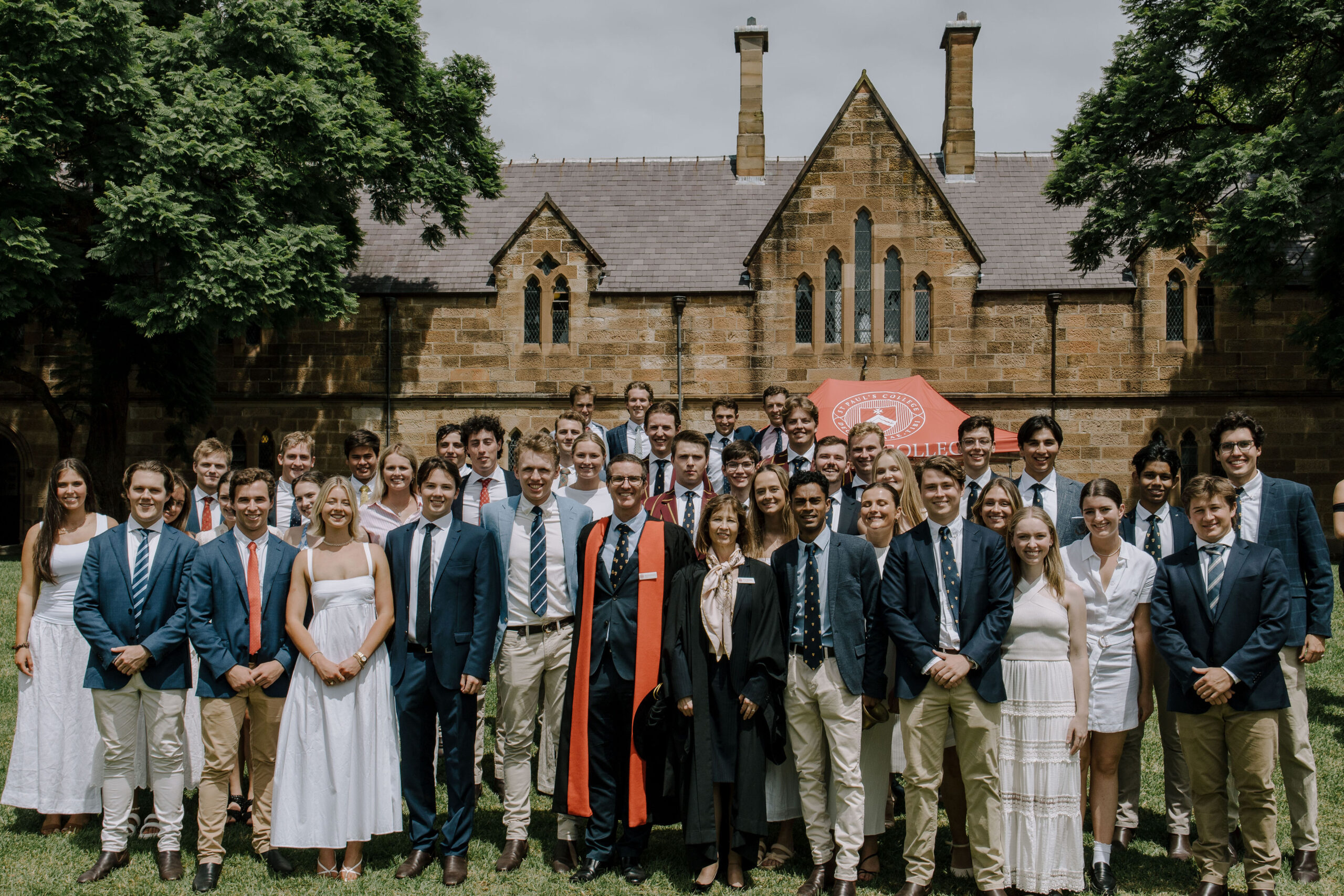
The St Paul’s College Foundation sits at the very heart of the College, sustaining its mission through the generosity of the Pauline community. Established in 1977 as a perpetual endowment, the Foundation ensures that every gift supports the College not only today but for generations to come. Through the support of alumni, parents, and friends, the Foundation now funds more than half of all scholarships at St Paul’s, helping ensure that financial circumstances are never a barrier to opportunity.

Since the first Foundation Scholars were named in 1983, the Foundation has supported more than 600 scholarships. These scholarships enable talented students to contribute fully to the academic, cultural, and leadership life of the College, continuing a tradition of supporting future generations and strengthening the life of the College.